



Many companies think about video too late: the website is live, campaigns are running, social channels are polished, yet potential customers still do not understand why this particular business deserves their trust.
Some things simply cannot be explained well through copy alone. A company can spend paragraphs describing product quality, a skilled team, attentive service or modern equipment. Thirty seconds of strong video can communicate that standard faster than a long page.
That is why video production today has become more than just a beautiful addition to marketing. For many businesses, it is turning into a trust, sales and positioning tool.
A good video does more than talk about the company. It makes the business feel credible.
Why video works faster than text
When someone first visits a company website, they rarely read every word. They scan the page, look at images, headlines, reviews and examples, then decide whether the business deserves more attention.
At that point, video can dramatically shorten the path to trust.
If video shows the real product, process, team, atmosphere, service detail or customer result, it creates a sense of direct contact. The viewer is no longer reading promises; they are seeing proof.
This matters wherever buying depends on trust: healthcare, construction, repairs, property, hospitality, education, manufacturing, e-commerce, B2B services, digital, consulting and premium local services. Customers are not only buying the service. They are buying confidence in their choice.
The main mistake of business videos
Most weak business videos do not fail because of the camera, edit or image quality. They fail because they lack a clear idea.
The company tries to show everything at once: office, team, machinery, services, logo, owner, customers, awards, process and an elegant closing shot. The result is a collection of attractive but disconnected scenes.
After watching, the viewer still cannot answer the only question that matters: why choose this company?
A good video is always built around one strong task. It can explain a complex service, show the quality of the product, build trust in the team, reveal the atmosphere of the brand, demonstrate the process, sell a specific service or strengthen an advertising campaign. But if a video doesn’t have a clear purpose, it almost always becomes just a beautiful file in a folder.
Business video should not begin with “What shall we shoot?” It should begin with “What decision should the viewer make afterwards?”
Website, advertising and social video need different cuts
Business owners often want one universal video for everything: the website, advertising, Instagram, sales messages and presentations.
Sometimes that is possible. More often, it weakens every use case.
A website video speaks to someone who has already shown interest, so it can add context, demonstrate the process and build deeper trust. An advert has a different job: the viewer was not thinking about your business, so the opening seconds must earn attention. Social video needs to be faster and simpler because it competes with an endless feed.
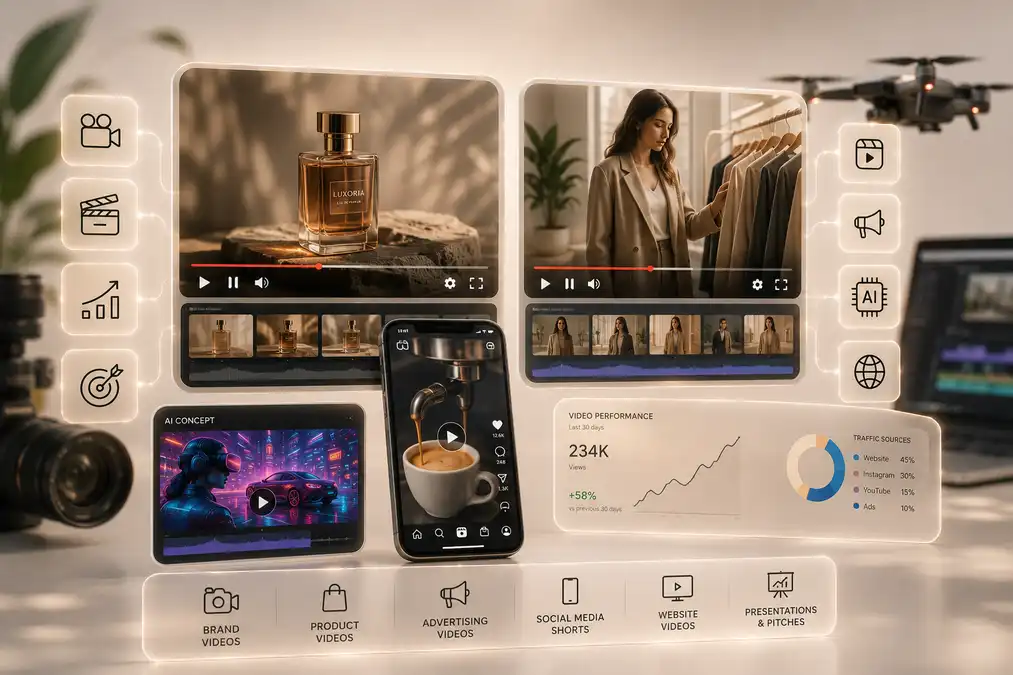
Strong production is therefore increasingly planned as a set of formats rather than one long film. A hero cut can live on the website, shorter versions can run in advertising, vertical edits can serve Reels, TikTok and Shorts, and individual clips can support presentations, case studies and newsletters.
Which videos does a business actually need?
Not every business needs a major brand film. A short series answering specific customer questions can be far more useful.
For a local company, a short process video can show how the consultation works, what the service looks like, what customers receive and how the team operates. For an online store, product video can demonstrate details, compare options and guide the choice. For B2B, a case-study film can show the brief, the solution and the result.
Other useful formats include adverts, service explainers, company films, customer testimonials, product demonstrations, event highlights, behind-the-scenes footage, training videos and short expert clips from the owner or team. Each solves a different problem, so the channel and sales role should be clear before filming begins.

Why AI video has become a business tool in its own right
AI video has changed the production landscape. High-quality visualisation once required a crew, location, lighting, actors, props and a serious budget. Some briefs can now be solved differently.
AI can create advertising concepts, visualise products before launch, build atmospheric explainer scenes, produce unusual creative and test campaign ideas. It is especially useful when live filming would be difficult, expensive or premature.
A company can preview a product still in development. A property developer can visualise a future space. A manufacturer can present an idea with impact. An agency can test several campaign directions before full production. A local business can create striking social content without a complex shoot.
AI video does not replace traditional production. It adds another layer of flexibility.
Real shooting and AI video work better together
Asking whether live action or AI is better misses the point. They solve different problems.
Live action is indispensable when the audience needs to see a real team, workshop, office, service, restaurant atmosphere, specialist at work, clinic, event or physical product. It proves that the business is real.
AI is stronger when the brief calls for an idea to be visualised, an impossible scene, rapid concept testing or an effect that would be prohibitively expensive to film.
The strongest modern approach often combines both. Live action brings credibility; AI brings speed, variation and visual freedom. Together they can produce richer content more efficiently than traditional production alone.
Video matters most when the result is hard to imagine
Some products are easy to understand from a clear image and price.
But there are areas where results need to be shown.
What will the renovated interior look like? How does the equipment work? What happens during the clinic procedure? What does the finished product look like? How is it made? How does the service or training work? Video can answer these questions in seconds.
In such situations, the video removes uncertainty. It shows not only the result, but also the path to it.
This matters because uncertainty almost always suppresses conversion. The less customers understand what to expect, the more likely they are to delay or choose a competitor that explained it better.
Why video enhances the website
A website without video can work well. But a site with the right video often performs better.
On the homepage, video can establish the level of the brand. On a service page, it can explain the process. In a case study, it can prove the result. In an online store, it can reveal a product better than still images. On the About page, it can introduce the team and make the business feel real.
Video should never be inserted as decoration. Put it where it helps someone decide. In the right place, it can hold attention, answer questions, build trust and improve enquiry quality.
Why video strengthens advertising
Video gives advertising what static creative often lacks: movement, emotion, context and an immediate visual hook.
An advert should be shorter, simpler and more precise than a website film. The opening seconds must explain why the viewer should keep watching. If it spends too long on an intro, logo or generic claims, the audience scrolls past.
The best advertising videos make the problem, outcome or hook obvious immediately: a before-and-after, product demonstration, short use case, arresting visual, unusual AI scene, real process or specific benefit.
Why businesses need a video system, not one video
The strongest strategy usually starts with one main video, but does not end there.
One filming day can produce a brand film, short advertising cuts, vertical social videos, website clips, case-study footage, behind-the-scenes material, expert comments and answers to common customer questions.
This makes production far more efficient. The business invests in a library of content that works across the digital journey, not a single film used once.
When the video really pays off
Video does not earn its keep through direct sales alone. Its wider effect can be just as valuable.
Customers understand the service faster. Sales teams receive better-prepared enquiries. Advertising earns more attention. The website feels stronger, social channels come alive and the business appears more established. The same assets can support emails, presentations and negotiations.
Video works especially well for businesses where trust, visuals, atmosphere, expertise and explaining a complex product are important. If a customer needs to “see to believe,” video content can become one of the most powerful digital presence tools.
Conclusion
Business video production is no longer simply about beautiful footage.
Today, video is part of the sales and trust system. It explains complex offers, proves the company's standard, strengthens the website, sharpens advertising, brings social channels to life and helps customers decide faster.
At the same time, modern video production is no longer limited to classical shooting. Real-life videos, AI videos, ad creatives, product demonstrations and short formats for social media can work together and reinforce each other.
The goal is not merely to make a video.
It is to solve a clearly defined business problem.
Explore how we approach website films, advertising, social content and AI creative on our video production page.
Want video to work harder for sales?
Pump Agency builds video into the wider digital system: from business and product films to AI video, advertising creative, short social formats, event highlights and content for websites and presentations.
If your offer is difficult to explain in copy, your product needs to be seen or trust must be built before first contact, video can become one of the strongest parts of your digital presence.
Discuss a video