



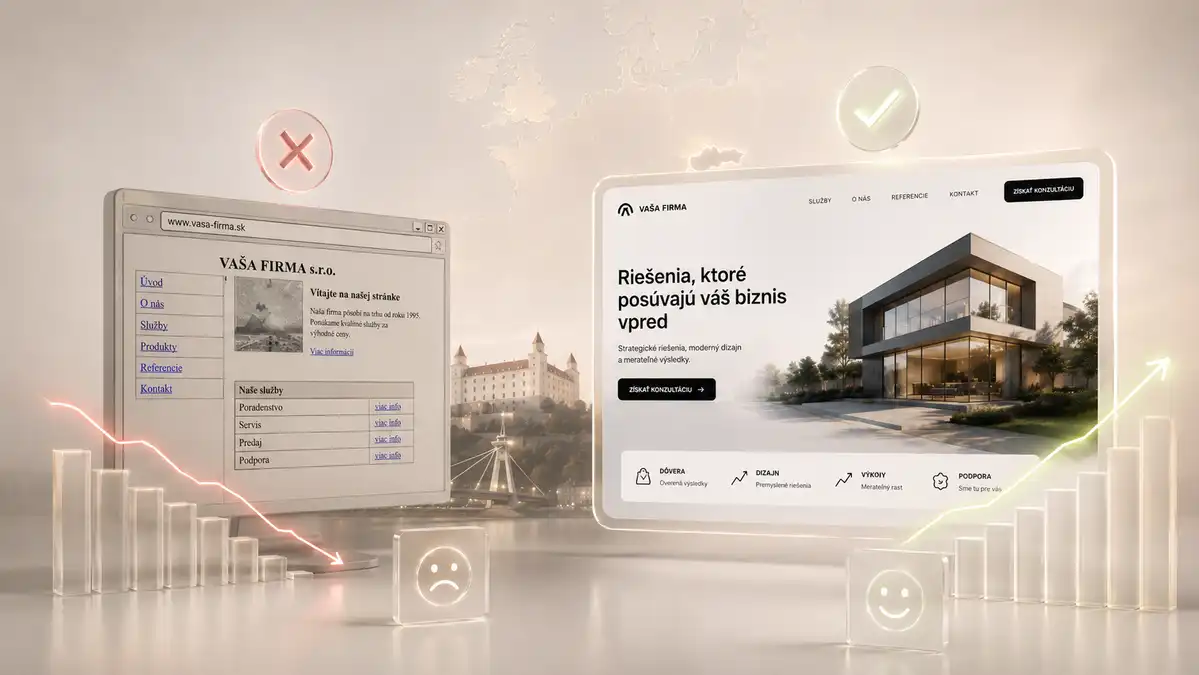
Many business owners judge a website too simply: it opens, so it works. There is a logo, a list of services, contact details and a form; perhaps a few enquiries still arrive. Nothing appears urgently wrong.
A website can work technically and lose customers every day.
This is especially true in Slovakia, where the market is changing quickly. Across Bratislava, Trnava, Nitra, Žilina, Košice and other cities, competition is rising and customers routinely compare businesses online. The first impression now forms in seconds on the website, not during a call.
An outdated website may not look disastrous. It can feel tidy, familiar and perfectly “normal” to the owner. To a new customer, however, it may look unconvincing, dated or too risky to trust.
The real danger is invisible loss. Analytics show the visitors who arrived, but not the potential customers who closed the page and chose a competitor.
An old website breaks trust before a customer examines the offer
When someone first opens a company website, they do not yet know the quality of the service, the team's experience, the owner's integrity or the results the business delivers. They will only discover those things if the first impression earns the next step.
They judge the visible signals first: how the website looks, how clearly it explains the services, whether mobile feels effortless, whether there are genuine case studies, reviews and photos, and whether the path to an enquiry is obvious.
If the website looks dated, slow, chaotic or awkward on mobile, doubt appears. Customers may never articulate it; they simply feel that the company looks weaker than the competition and close the tab.
That is not always fair. A strong team and excellent product may sit behind an old website. But the market cannot value what the business knows about itself; it can only judge what customers see.
Customers in Slovakia are used to comparing
Recommendations, signage, a Facebook page and a simple website once carried many local businesses. Today the customer journey is longer. Even referred customers usually check Google, open the website, read reviews, scan photos and compare alternatives before they call or write.
This matters especially in Bratislava, where competition is higher and a customer may compare several businesses in a single evening: three dentists, two builders, several e-shops or a handful of digital agencies. The best service does not automatically win. The business that communicates its value fastest and most clearly often does.
An old website works against the company, creating doubt exactly where it should support the sale.
The problem is not always design
When owners think of an outdated website, they often picture old colours, tired fonts, irrelevant photos and weak visuals. Those things matter, but the problem usually runs deeper.
Outdated websites often have weak structure. Services are described too vaguely, pages fail to answer real questions, navigation lacks logic, the enquiry form is buried, mobile is awkward, loading is slow, SEO has stood still and the content no longer reflects the company’s true standard.
As a result, the site seems to exist, but does not serve as a seller. It does not explain, persuade, remove objections, or lead a person to the next step.
A modern website should support sales. It must answer the questions customers would otherwise ask the team: what you do, who you help, why they should trust you, which results you can show, how the process works, what it may cost and what happens next.
If these answers are not available, the site becomes just a digital business card. And business cards aren't enough anymore.
Mobile is now the real test
In many sectors, the first visit happens on a phone: while travelling, at home in the evening, during a break, after a recommendation or directly from Google Maps. If mobile is awkward, the company loses part of its audience immediately.
Many older websites were built when desktop was the primary screen. They may still look acceptable on a computer, then fall apart on mobile through tiny text, awkward buttons, long blocks, slow loading, clumsy forms and poor navigation.
Customers do not diagnose that as a technical problem. They simply feel that dealing with the company may be difficult.
That feeling is often enough to send them to a competitor.
An old website makes advertising more expensive
One of the most common business mistakes in Slovakia is that a company tries to fix a weak website with advertising. The logic is clear: fewer enquiries, so you need more traffic.
But advertising doesn't correct distrust. It just brings more people to the same site.
If the landing page is weak, the offer unclear, the form awkward, loading slow and the company visually dated, the advertising budget burns faster. People click but do not enquire, cost per lead rises and the owner concludes that advertising does not work.
The advertising may be working perfectly well. The website is simply failing to turn attention into an enquiry.
This is especially critical for high-value services, B2B, construction, healthcare, e-commerce and digital. The more expensive the decision, the more trust the website must create before the enquiry.
An outdated website limits SEO
SEO also suffers from an old website. And it's not just about keywords.
If the structure is weak, services barely explained, loading slow, expert content absent and internal linking poor, Google has fewer reasons to rank the website above competitors.
This matters especially for local businesses in Slovakia. Searches such as “web design Bratislava”, “dentist Bratislava”, “garage Nitra”, “online store Slovakia” or “construction company Trnava” require more than a website. Google needs to understand what the company does, where it operates, how useful the content is and whether the business shows credible trust signals.
The old website often does not give these signals. It can exist for years, but hardly grow in search.
The site may not match the real level of business
This is one of the most costly gaps. The company grows, improves its service, hires a team, delivers stronger projects and wins more serious clients—while the website remains stuck in the early years.
The owner already knows that the company has become stronger. Regular customers know that too. But the new customer only sees outdated digital presence.
The result is a gap between the actual level of business and how it looks online.
That gap directly affects the quality and value of enquiries. If the company looks cheaper than it really is, customers are more likely to haggle, compare only on price and overlook it as a serious partner.
Signs that it is time to update the website
Review the website if the team is reluctant to send customers its link. That is an honest signal. If owners or managers would rather explain everything in messages than direct someone to the website, it is no longer doing its job.
Customers are constantly asking the same questions, although the answers should be on the site. This means that structure and content don’t help sales.
Other warning signs include poor mobile performance, slow loading, outdated services, missing case studies, disconnected analytics, stagnant SEO, weaker presentation than competitors or years without meaningful updates.
Another red flag: advertising drives traffic but enquiries remain scarce. The problem may lie not in the adverts, but in the landing page and the trust created by the website.
What should a modern website do?
A modern website does not have to be overloaded with animations and complex effects. It should be understandable, fast, persuasive and linked to real business challenges.
For a local company, the website should explain services, establish trust, make contact easy and strengthen its Google presence. For e-commerce, it should guide purchases and support the catalogue, payment, delivery, analytics and marketing. For B2B, it should explain complex services, demonstrate expertise and case studies, clarify the process and reduce the risk of choosing a partner.
The main question is not “Is the website beautiful?” It is whether the website helps the right customer decide to contact you sooner.
Why a website upgrade pays back in more than enquiries
Some owners expect an immediate surge in enquiries from a new website. That can happen, especially when the old site is weak, but the wider effect is often more valuable.
A stronger website improves how the company is perceived, raises advertising efficiency, supports SEO, gives sales teams better material, reduces repetitive questions and brings the digital presence up to the standard the business already delivers.
The return therefore comes not only through new enquiries, but through a healthier digital system.
Conclusion
Slovak businesses often lose enquiries not because the product is poor or the team weak, but because the website no longer matches customer expectations or the competitive market.
An outdated website may work technically while eroding trust, weakening advertising, limiting SEO and understating the business’s perceived value.
In 2026, a website is no longer a one-off digital business card. It is part of sales, marketing, Google visibility and the company’s wider digital presence.
If the business has grown and the site has remained the same, sooner or later this gap starts to cost money.
Does your website undersell your business?
Pump Agency helps companies across Slovakia and Europe rebuild websites for measurable business impact: stronger trust, more enquiries, better SEO and advertising performance, sharper mobile UX and room to grow.
If your website still runs but no longer reflects the standard of your company, it may be time to rebuild it as a modern sales tool—not merely give it a cosmetic refresh.
Discuss a website upgrade