



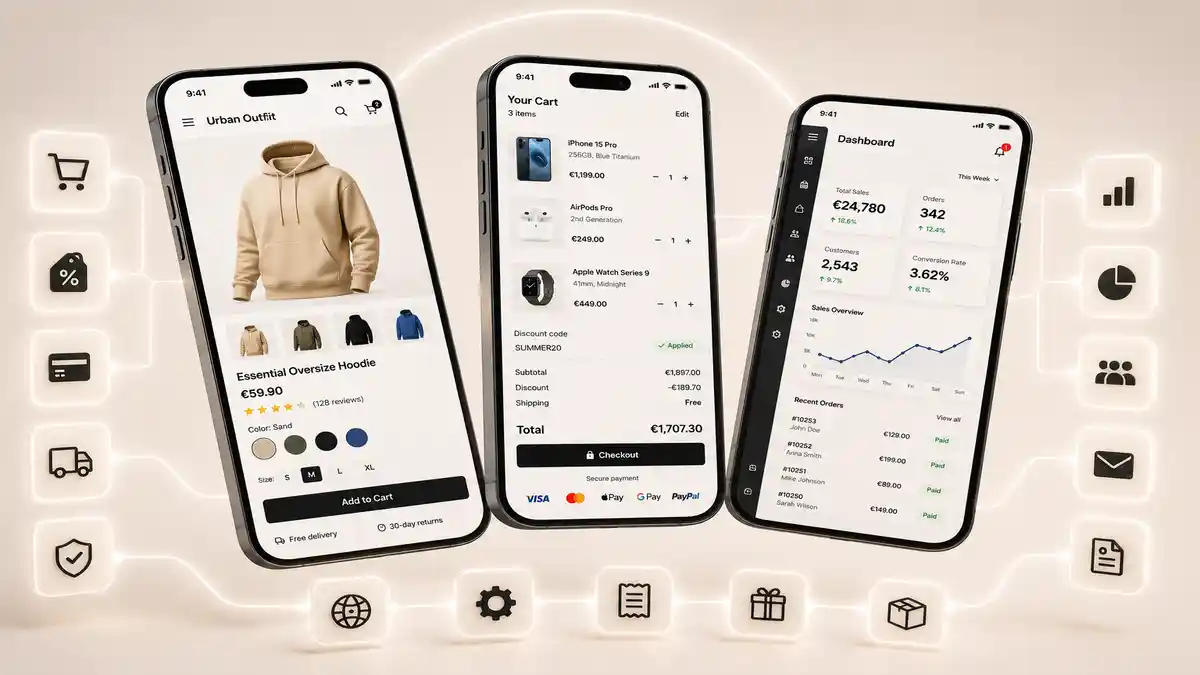
Many business owners still think of an online store as a website with products, a basket and a payment button. If an item can be added to the basket, an order submitted and a confirmation sent, the job appears to be done.
Modern e-commerce has moved far beyond that.
Today, an online store has to do far more than display products. It should guide decisions, reduce doubt, automate order handling, connect payments and delivery, support multiple markets, collect useful analytics, feed advertising platforms and save the team time. In short, it should operate as a sales system.
This is especially important for businesses in Europe, where an online store often has to work with multiple languages, countries, currencies, delivery methods, legal requirements and customer expectations.
So the question is no longer: “What pages does the online store need?”
The right question is, “What system does a business need to sell online without chaos?”
A modern online store starts with buying logic, not design
Design is important. It forms a first impression, helps the brand look stronger and influences trust. But a good online store doesn’t start with a beautiful banner on the homepage.
It starts with the customer journey.
Customers should quickly understand what is being sold, how to choose the right product, which options are available, what it costs, how to order and pay, when delivery will arrive and where to turn with questions.
If this path is difficult, the customer leaves.
That is why a modern online store depends on more than visuals. Catalogue structure, filters, product pages, search, basket, checkout, notifications, customer accounts, mobile experience and post-purchase logic all matter.
An online store should guide the purchase without making customers decipher someone else's internal system.
Build the catalogue for the buyer, not the owner
One of the most common e-commerce mistakes is building the catalogue around the company's internal logic. The owner knows every product, category, SKU and subtle difference. The customer sees it all for the first time.
A modern catalogue should therefore be organised around how customers choose.
Simple products may need only clear categories, photography, prices and descriptions. A complex range may require filters, parameter-based selection, comparisons, guidance, configurators, compatibility rules and dependent options.
In a car-mat store, customers need to select a set by vehicle make, model, year, body type and other parameters. Furniture may depend on dimensions, materials, colours and configurations. Fashion needs sizing, stock, returns guidance and photography on real models. Building materials depend on specifications, volume, delivery and compatibility.
The more complex the product, the more the online store should help the customer make a decision.
A product page should sell, explain and remove doubt
The product page is one of the most important parts of an online store. It is often where the purchase decision is made.
A weak product page shows a photo, a price and a “buy” button. A strong one explains the product, presents the options, answers questions and removes objections.
A modern product page can include photography, video, specifications, configuration options, colours, sizes, materials, availability, delivery times, payment methods, reviews, FAQs, recommendations, related products, accessories, bundles, dynamic pricing and a clear explanation of the value.
If the product is customisable, the product page should act as a focused configurator. Customers choose the parameters, see the price update, understand what is included and can buy without fearing an expensive mistake.
Checkout should be short, clear and frictionless
Many stores lose revenue not in advertising or the catalogue, but at checkout.
The customer has chosen the product and is ready to buy. Then they meet a long form, unclear delivery, unnecessary fields, a missing payment method, mobile errors or surprise costs.
At this point, some buyers just leave.
Modern checkout should be fast, logical and effortless on mobile. Buyers should know what they are purchasing, how much they will pay, when it will arrive, which payment methods are available and what happens after the order.
European stores must account for different countries, delivery methods, currencies, languages, taxes, legal requirements and customer expectations. What feels effortless in one market may feel awkward in another.
Payment should be built into the system, not screwed on top
Online payment is a basic part of modern e-commerce. Visa, Mastercard, Apple Pay, Google Pay and other familiar methods reduce friction and make the store feel more credible.
Payment logic matters behind the scenes too.
It should connect with the order, status, notifications, documents, analytics and administration workflow. Once payment succeeds, the system should update the order, send confirmation, generate the relevant document, prepare delivery data and record the event in analytics.
That’s why a payment system should be part of an e-commerce architecture, not a single module that simply accepts money.
Automatic invoices and documents save business hours
Paperwork is one of the most underestimated parts of e-commerce.
When order volume is low, invoices can be handled manually. As the store grows, that admin quickly becomes a constant burden, creating errors, delays, confusion and dependency on one employee.
A modern online store should automate routine documents. After an order, the system can generate an invoice, send it to the customer, attach it to the order, store it in the administration and connect it to the next processing step.
This matters particularly for European businesses, where orderly documentation supports both compliance and operational stability.
Delivery must be clear before payment
Delivery in e-commerce should not appear as a surprise at the end of the purchase.
The buyer wants to understand in advance where the store delivers, how much it costs, what options are available, when the order will arrive and whether it is possible to track the shipment.
Delivery becomes more complex across Europe. One store may serve Slovakia, Czechia, Poland, Austria, Germany, Hungary and beyond, with different lead times, prices, carriers and customer expectations in each market.
A good online store should recognise the customer’s country, present the right delivery options and costs, pass accurate data to logistics partners and keep order statuses current.
Delivery tracking matters too. When customers know where an order is, they contact support less often and feel more confident after the purchase.
Notifications and email marketing keep the relationship alive
Customers should not be left in silence after they buy.
A modern online store should send clear updates when the order is accepted, payment succeeds, preparation begins, the parcel ships, delivery is on its way and documents are available. These emails do more than inform; they create control and demonstrate professional service.
Beyond service messages, email marketing can support repeat purchases, promotions, recommendations, abandoned-basket recovery and customer reactivation.
This is an important layer of e-commerce because the first sale is often the most expensive to win. If the store ignores customers after purchase, it gives away future revenue.
Multilingualism in Europe must be thought out in advance
For a European online store, multilingualism is often not an advantage, but a necessity.
But a multilingual e-shop is not simply a translated interface. It needs a deliberate URL structure, SEO and hreflang for every language, properly localised product pages, currencies, shipping, legal pages, emails, notifications and administration.
Slovak, Czech, Polish, German and English versions may differ in more than language. Each market brings different needs, expectations, trust signals and buying habits.
If that architecture is not planned early, adding another market later can become expensive and painful.
Currency, country and locality should work together
If a store sells across Europe, customers should immediately understand whether it serves their country.
Language and currency are only the start. Delivery coverage, payment methods, legal information, lead times, returns, local trust signals and market-appropriate communication all matter.
For example, a Czech customer who sees their language, a familiar currency, clear delivery, credible returns terms and recognised payment methods feels less risk. If everything looks like a foreign website that “might deliver”, trust drops.
Localization in e-commerce directly affects conversion.
Admin should be comfortable for a real team
The buyer sees the frontend. But the team works in the admin every day.
This is where products are added, prices updated, order statuses changed, customers supported, discounts created, documents checked, language versions managed and processes controlled.
If the admin is uncomfortable, the business is wasting time every day.
Roles and permissions matter as an online store grows. Owners, managers, content specialists, marketers, accountants and warehouse staff should not share identical access. A good system gives each person the permissions they need while keeping processes under control.
This is especially important when the store stops being a small project and becomes part of the daily work of the team.
Bundles, discounts and free-delivery prompts can lift order value
Discounting does not have to mean cutting every price. Modern e-commerce can use far smarter incentives.
Offers can depend on bundles, quantity, category, order value, selected options or customer behaviour. Stores can recommend accessories, added services, upgraded sets and relevant cross-sells.
One simple but effective feature is a free-delivery progress message. If customers see that another €12 or €20 unlocks free delivery, they are often more willing to add another product.
These features should never feel intrusive. Used carefully, they can increase average order value while making the purchase more useful to the customer.
Search and filters can decide whether an order happens
If there are more than a few dozen products in the store, search and filters become critical.
Customers do not want to inspect the entire catalogue manually. They want to narrow it quickly by size, price, colour, model, brand, purpose, compatibility, availability or another meaningful parameter.
Bad filters create irritation. Good filters create a sense of control.
In a complex store, filtering can matter more than the homepage. Customers arrive to find the right product, not admire the brand.
Analytics should not only show visits
The eShop owner needs to understand what is going on inside the store.
Where do visitors come from? Which products do they view? Where do they abandon the basket? Which channels drive sales, which categories are growing and which products stall? How does average order value change? Which pages create friction? Which countries perform best?
Without analytics, the store runs on guesswork.
A modern online store should connect analytics, advertising accounts, events, conversions and reporting—especially when the business invests in Google Ads, Google Shopping, Meta Ads, SEO or email marketing.
Google Shopping needs to be considered in the development phase
Google Shopping can be one of an online store’s strongest sales channels, but only when the store is technically ready.
That requires accurate product names, descriptions, images, prices, stock, categories and feeds, alongside clear legal pages, delivery, returns and Merchant Center compliance.
If the catalogue is chaotic, Google Shopping will underperform or demand extensive rework.
A strong online store is therefore designed with the understanding that products must work not only on the website, but across advertising, search and commerce platforms.
Security and stability cannot be delayed
The online store works with orders, customer data, payments, addresses, documents and internal processes. Therefore, security cannot be a secondary concern.
You need secure payments, SSL, updates, backups, admin protection, access control, stable hosting and a clear support process.
A brochure website can survive a temporary issue. An online store can lose revenue immediately.
Post-launch support is part of the project
Starting an online store is not the endgame.
After launch come real data, customer behaviour, support questions, new ideas, bugs, seasonal patterns, campaigns and opportunities in new markets.
A modern online store should be built to evolve. The team should be able to add languages, features, integrations, pages, marketing modules, automation and reporting without rebuilding the project from scratch.
If the store cannot be properly developed, it quickly begins to become obsolete.
What it looks like in practice
We implemented many of these capabilities for EVA-MAT, transforming a limited legacy store into a complete e-commerce platform for the European market.
The project required a complex car-mat catalogue, product customisation, online payment, automated invoices, delivery, notifications, email marketing, administration roles, Google Shopping readiness, European localisation and room to scale.
Conclusion
A modern online store is no longer a product catalogue with a basket.
It is a system combining product discovery, payments, delivery, documents, notifications, marketing, analytics, localisation, Google Shopping, administration, security and future development.
Not every feature is needed on day one. But if the architecture ignores these capabilities, the business will quickly hit a ceiling.
A good online store should sell today and be ready to grow tomorrow.
Do you need an online store as a sales system?
Pump Agency helps businesses in Slovakia and Europe create modern eShop platforms: from directory structure and UX to payments, delivery, automated invoices, Google Shopping, email marketing, analytics, localization and process automation.
If you are planning to launch an online store or feel that the current eShop is no longer able to cope with growth, you should start not with choosing a template, but with designing a complete sales system.
Discuss an e-shop