



There is a point that many entrepreneurs notice too late: a business can grow faster than its website.
At the start, almost any simple solution can feel adequate: a website builder, basic storefront, manual order handling and minimal automation. That may support the first sales. As orders and the range grow, however, advertising, new countries, multiple languages, European delivery and serious analytics expose every limitation. The old website stops helping and starts holding the business back.
That was the point EVA-MAT had reached.
The company manufactures car mats for the European market. It already had customers, orders and demand, but its digital infrastructure was too weak for the next stage: an old website-builder store, no complete online-payment flow, too much manual work, limited catalogue tools and little room to scale.
The goal was not just to create a new online store.
The challenge was to build an e-commerce system capable of selling across Europe, automating routine work and managing a complex catalogue, payments, delivery, invoices, notifications, Google Shopping, customer data and marketing.
The old website could no longer keep up with the business
For many companies, an old website stays in operation not because it’s good, but because it “works somehow.” Orders are still coming, managers are coping, customers are writing, business is moving. But the hidden price of such a system is gradually accumulating inside.
For EVA-MAT, the cost appeared as manual processing, website-builder limitations and an inability to develop the store properly for Europe. Without a complete payment flow, automated documents, reliable delivery, flexible administration and accurate analytics, more orders simply created more manual work and more chaos.
This is a typical trap for growing e-commerce. As long as the store is small, manual processes seem tolerable. When businesses start to scale, they become a constant brake.
The new store needed to support the complete sales process
In a strong online store, features cannot be treated in isolation. Payment, delivery, invoices, order statuses, emails, discounts, languages, currencies, catalogue, Google Shopping and administration must work as one system.
The website should move a product choice smoothly towards purchase. Once placed, the order should flow through the system without unnecessary manual work. Status changes should trigger customer updates, delivery data should reach the right service and every European market should connect language, country, currency and terms coherently.
That became the foundation of EVA-MAT.
The new eShop was created not as a beautiful storefront, but as a working platform for sales, where each element was to either increase the customer’s convenience, reduce the burden on the team, or help the business scale.
The EVA mat catalogue was a system in its own right
Car mats may look like a simple product. In reality, the store succeeds or fails on the selection logic.
The buyer needs a set for a specific make, model, year, body type and sometimes additional parameters. Any doubt about compatibility adds friction and reduces conversion.
The catalogue and selection journey therefore became central to the project. Buyers should not feel the complexity of the range: choose a car, see compatible options, customise the set and order.
Internally, it requires a well-thought-out data architecture, dependencies, product options, and convenient admin so that the business can manage it without constant developer involvement.
Customisation became a core part of the store
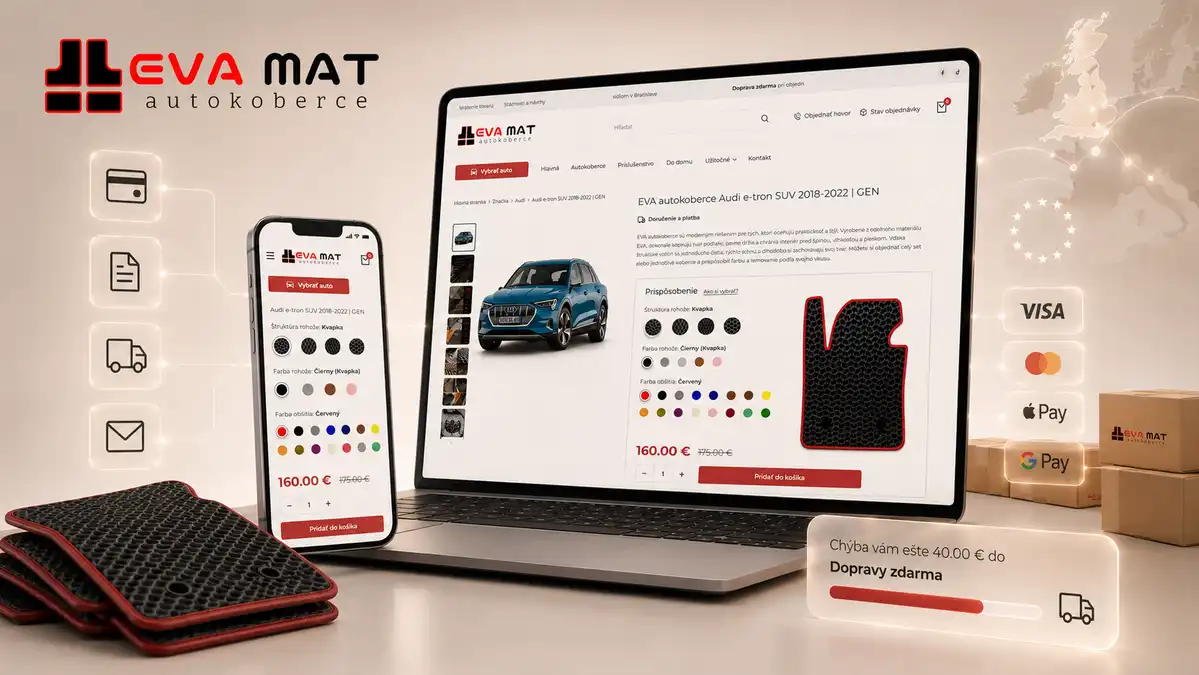
For EVA-MAT, it was important not just to show finished products, but to give the customer the opportunity to choose the desired configuration. In such projects, the product card turns not into a static page, but into a small configurator.
Users can choose set parameters and additional options while seeing how each decision affects the final price. Different products require different configuration logic, so one generic product template would not work.
Such features are especially important for stores where goods are not always sold in one fixed form. It may not be just a car theme. The same logic is relevant for furniture, building materials, equipment, gift sets, clothing, interior solutions and any goods with configuration options.
Payment became part of the purchase, not a manual procedure
One big step forward for EVA-MAT is full online payment.
For European e-commerce, this is no longer an additional feature, but a basic customer expectation. The buyer wants to pay for the order by card or in the usual way without unnecessary correspondence. Therefore, modern payment capabilities were connected to the project, including Visa, MasterCard, Apple Pay and Google Pay.
For customers, this means a clear checkout. For the business, it means less manual processing, fewer lost orders and a more professional service.
Payment never operates alone. It connects to the order, status, documents, emails, analytics and fulfilment. When those parts work together, the store behaves like a commercial system rather than a collection of pages.
Automatic invoices and documents save team time
One of the most underrated parts of e-commerce is document management.
With only a few orders, documents can be prepared manually. As sales grow, that routine consumes time and creates errors.
EVA-MAT automated invoicing and related processes. After an order, the system generates the necessary documents and links them to the purchase. That creates a clear customer experience and keeps European operations organised.
Such automation does not look spectacular on the screenshot, but it makes the store convenient for real daily work.
Delivery became part of the system, not a manager’s manual task
For an online store that operates across Europe, delivery is one of the key processes. It's not just a line in checkout. It is the logic of countries, terms, cost, orders, notifications and customer expectations.
Automation of delivery and order processing was included in the project, so that data did not have to be manually transferred from one system to another every time. When an order is made, the business needs to quickly understand what’s going on and the customer needs to get clear information about the process.
Separately important is the ability to track delivery and order status. For the customer, this reduces anxiety after the purchase. For business, it reduces the number of similar support questions.
Email marketing and notifications make the store live
After placing an order, communication with the customer should not end.
EVA-MAT introduced automated emails and notifications throughout the order journey. Customers receive confirmation, know the order has been accepted and can follow status changes without chasing the team.
In addition to operational letters, e-commerce offers opportunities for email marketing: repeat sales, reminders, promotions, working with the customer base, returning customers and communication after purchase.
Many entrepreneurs underestimate this level. They only think about the first order. But a strong online store should work not only for the first sale, but also for repeated touches with the customer.
The discount system and free delivery affect the behavior of the buyer
In e-commerce, small things often have a strong effect.
Take progress towards free delivery in the basket. Showing how much remains can encourage a larger order without turning the journey into an aggressive upsell.
The same applies to discounts, which depend on the set, order conditions or selected parameters. If the discount logic is implemented correctly, it helps the business manage the average check and stimulate the right customer behavior.
Such features seem small, but they are what make up the modern eShop. Not one big “magical” tool, but dozens of clever details that together improve sales.
Administration became the team’s operating centre
The customer sees only the outside of the store. But the team works inside the admin every day.
Therefore, it was important for EVA-MAT to make not just a beautiful frontend, but a convenient system for managing orders, products, customers, documents, statuses, marketing and content.
Roles and permissions matter. Not every employee should see or edit the same information. Managers, administrators and owners need different tools, and a sound permission model protects both order and security.
Administration is not secondary. It is the team’s daily workplace, and a poor experience wastes time every day.
European localisation went far beyond translation
EVA-MAT is focused on several markets: Slovakia, Czech Republic, Poland, Austria and other European destinations. Therefore, localization could not be limited to simple translation of texts.
European e-commerce must connect language, country, currency, delivery, payments and local expectations. Visitors from another market need to understand how to order, which terms apply, when delivery happens and how they can pay.
The project implemented logic that helps to adapt the store to different markets. This is especially important for a business that doesn’t want to redesign a website every time it enters a new country.
Google Shopping is part of the architecture, not the final setup
Google Shopping was an important channel for EVA-MAT because products needed visibility beyond the store and throughout Google’s product ecosystem.
For this to work, the store must be technically prepared: correct products, prices, images, availability, data for the feed, directory structure, legal pages and compliance with the requirements of Google Merchant Center.
Google Shopping cannot be treated as “connect the ads later”. Its requirements belong in the store architecture from the beginning.
This is what distinguishes an ordinary online store from a store ready for real e-commerce promotion.
What other entrepreneurs can take from this case
The most valuable thing about this project is not that it is related to car mats.
The most valuable thing is that almost any growing online store takes a similar path.
The business starts simply, makes its first sales and grows the range. Then come advertising, new countries, payments, delivery, documents, customer data, email, discounts, analytics, Google Shopping and a larger team. If the system is not ready, each new stage creates another problem.
EVA-MAT showed that eShop needs to be designed not only for today, but also for the next level of business.
Separate case page
This article shows the business logic of the project and the main conclusions for entrepreneurs. On a separate page of the EVA-MAT case, you can view the project more visually: structure, interfaces, store pages, product card elements, basket, technical solutions and implementation details.
Conclusion
EVA-MAT shows how an online store can move from a simple storefront to a complete sales system.
The project combined a complex catalogue, product customisation, online payment, automated invoices, delivery, notifications, email marketing, administration roles, Google Shopping, European localisation and room for further growth.
It is projects like this that show why modern eShop cannot be judged by design alone. Its value lies in how well it helps businesses sell, serve customers, save team time and scale into new markets.
Has your eShop grown from an old website?
If your online store is struggling with growth, demands too much manual work or blocks expansion, the business may need a stronger e-commerce system rather than another cosmetic update.
Pump Agency creates online stores for Slovakia and Europe with catalogue, payments, delivery, automation, Google Shopping, analytics, localisation and long-term growth designed in from the start.
Discuss an e-shop