

“How much does a website cost in Slovakia?” sounds simple. In practice, it is one of the biggest sources of misunderstanding between a business and its development partner.
One owner needs a credible website for a small local service in Bratislava, so customers understand the offer and send an enquiry. Another needs a multilingual corporate website for Slovakia, Czechia and Austria. A third needs an online store with payments, delivery, Google Shopping, CRM and automated documents.
All three are “websites”, but the work, responsibility and budget behind them are completely different.
That is why a useful price discussion starts not with a number, but with the role the website needs to play in the business.
A €500 website and a €5,000 website solve different problems
The Slovak market offers everything from websites for a few hundred euros to apparently similar projects priced in the thousands. It is fair for an owner to ask: “Why such a difference if both are websites?”
Because appearance is only the surface. Visitors see design, copy, buttons and photography; the real cost sits deeper in the structure, business logic, mobile experience, SEO, performance, content management, analytics, integrations, security and room for future development.
A low-cost website can be perfectly sensible when the business needs a simple presentation page—for a local service, solo specialist or temporary launch. But when the website must generate enquiries, perform in search, support several languages, connect to CRM or scale into new services, the investment naturally rises.
In Bratislava, a website is a sales tool—not an online business card
Bratislava is a markedly more competitive market than many smaller towns. It has more international companies and more businesses serving customers in Austria, Czechia, Germany and across Europe. Expectations for a credible digital presence are therefore higher.
For a Bratislava company, the website is not merely a page on the internet; it is part of the sales journey. A customer may see an advert, open the website, check Google Maps and reviews, explore the services and only then enquire. If the website lacks credibility, the lead disappears before the first conversation.
Competition may be less intense in Nitra, Trnava, Žilina, Košice, Banská Bystrica or Prešov, but the logic is the same: customers compare businesses online. That matters especially in healthcare, construction, property, automotive services, education, B2B and e-commerce.
So the real question is no longer “What does it cost to put a page online?” It is “What does it cost to build a credible sales touchpoint for the business?”
What determines the price of a website
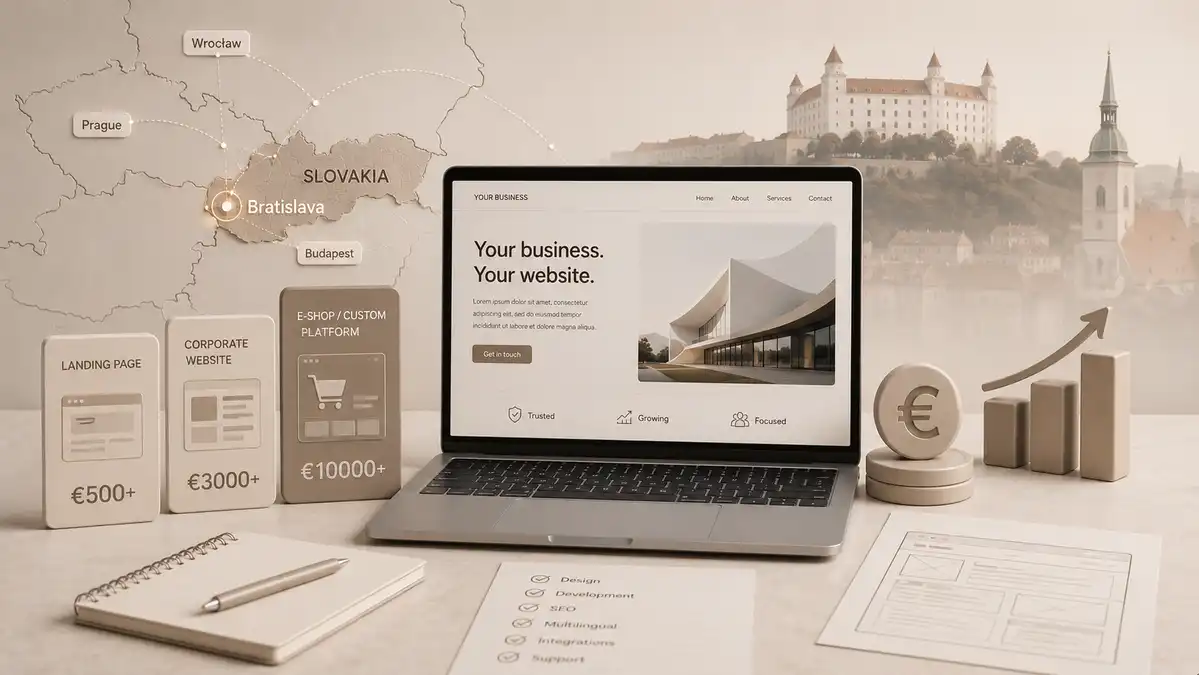
Several major factors shape the price. The first is project type. A landing page, company website, catalogue, online store and custom platform cannot cost the same because they demand different levels of strategy, design and development.
The second is structure. A five-page website and one with dozens of sections, a blog, case studies, filters, multiple languages and complex navigation require very different work, even if they share the same visual style.
The third factor is content. Many owners underestimate copy, photography, case studies, service descriptions and the order of the argument. Yet content is what tells a customer why the company deserves their trust. A partner who shapes that story rather than merely filling blocks adds real strategic work.
The fourth factor is technical quality. Speed, responsive behaviour, security, administration, analytics, basic SEO, enquiry forms, integrations and reliable mobile performance all take time. They may not be obvious on the first screen, but they determine how stable the project is.
Why multilingual websites cost more
Multilingual capability matters particularly in Slovakia. Many businesses are not confined to the domestic market: some work with Czechia, others target Austria and Germany, and many need English for international clients.
Adding languages looks simple: translate the copy and add a switcher. In practice, each version needs the right URL structure, local search intent, metadata, hreflang, content administration and a sensible workflow for future updates.
The Slovak, English, German, Czech or Hungarian versions of a website are not just copies of a single page. Different markets may have different queries, different communication styles, and different levels of trust in certain arguments.
For example, a Bratislava page may emphasise local knowledge, responsive communication and delivery in Slovakia. Prague or Brno may require different search intent. Vienna and German-speaking markets often place greater weight on precision, legal transparency and a very clear service structure. That localisation work affects the price.
Why businesses in Slovakia should think beyond one market
Slovakia sits in a strong position at the heart of Europe. Bratislava businesses can serve Vienna, Prague, Brno, Budapest, Kraków, Wrocław and other Central European cities more easily than many assume—especially in digital services, B2B, e-commerce, manufacturing, consulting and niche products.
Website planning should therefore account for whether the business will remain in Slovakia or expand into neighbouring markets. Ignore that question at the start and the project may later need costly structural changes: new languages, rebuilt SEO, a larger catalogue, different forms, new integrations and a redesigned customer journey.
A good website doesn’t have to be huge. But it should be made so that it can be developed without a complete restart.
Landing page, company website, catalogue or online store: why prices differ
A landing page is usually built for one service, product or campaign. Its job is to explain the offer quickly and lead the visitor towards an enquiry. It can be relatively affordable when the structure is focused and the logic straightforward.
A company website works differently. It needs to explain the business, services, advantages, case studies, team and process, and may also support a blog or several languages. It is the right format for companies that need to look established and win higher-value clients.
A product catalogue is more complex again because it introduces products, categories, filters, specifications and enquiry flows. It suits B2B companies, manufacturers and distributors where the purchase is not completed instantly online.
An online store is usually the most complex format. Beyond design and product pages, it must handle payments, delivery, order management, emails, statuses, customer accounts, SEO, Google Shopping, analytics, legal pages and staff administration.
Comparing the price of a landing page with an online store is therefore meaningless. They solve different business problems.
Why “website on a template” is not always bad
The template itself is not a problem. The problem begins when the template is used without understanding the business.
For a straightforward project, a proven template can be a sensible starting point—especially when the budget is tight and the business needs to launch quickly. It still needs adaptation: sharper copy, a tailored structure, on-brand visuals, a sound mobile experience, analytics and basic SEO.
A website is not weak because it uses a template. It is weak when nobody has considered how it should sell, explain and build trust.
Why post-launch support also impacts real cost
Many companies consider the website budget only up to launch. That is a mistake.
After publication, the website needs to live: information changes, pages are added, forms and analytics need monitoring, bugs need fixing, modules need updates, SEO evolves and conversion opportunities emerge.
Without reliable support and a clear structure, every edit becomes a small project. Within months, the website begins to date: it technically exists, but no longer evolves with the business.
Budget decisions should therefore consider both build cost and total cost of ownership. A stronger build can prove more economical when it is easier to maintain, extend and scale.
How much can a website cost in Slovakia?
A simple landing page or small brochure website may cost from a few hundred to a couple of thousand euros, depending on the quality of the design, copy and setup. A company website usually costs more because it needs a considered structure, substantial content, several sections, a polished mobile experience and SEO preparation. A catalogue or online store can cost significantly more, particularly with filters, languages, integrations, payments, delivery and automation.
Any figure without a brief means very little. A €1,500 website may be entirely appropriate for a local specialist and far too limited for a company competing in Bratislava, Prague or Vienna.
Price only makes sense in relation to the goal.
How to judge the budget your business needs
The most honest way to start is not with the price question, but with the role of the site.
A basic proof-of-existence website is one level. A website expected to generate enquiries from Google, support advertising, explain a complex service, work in several languages and assist sales is another. A platform with a catalogue, orders, payments, CRM and automation sits at another level again.
A good partner does not push the most expensive option by default. They explain honestly where the budget can be reduced and where cutting corners will create problems later.
Conclusion
Website costs in Slovakia vary enormously—and that is entirely reasonable.
Prices vary because the word “website” can describe completely different projects: a simple brochure site, a focused landing page, a company website, a catalogue, an online store or a custom digital platform.
For businesses in Bratislava, across Slovakia and in neighbouring European markets, a website is increasingly part of sales, trust and growth. When choosing a partner, look beyond the price and ask what commercial job the website must do.
Cheaper is not automatically worse, and more expensive is not automatically better. The right question is simple: what does your business need from its website for it to perform?
Are you planning a website in Slovakia?
At Pump Agency, we build websites for practical business goals across Slovakia and Europe—from focused landing pages and company websites to catalogues, online stores and custom digital systems.
We can help define the right format, identify which features genuinely matter, avoid unnecessary spend and invest early where a stronger foundation will support growth.
Discuss a website