



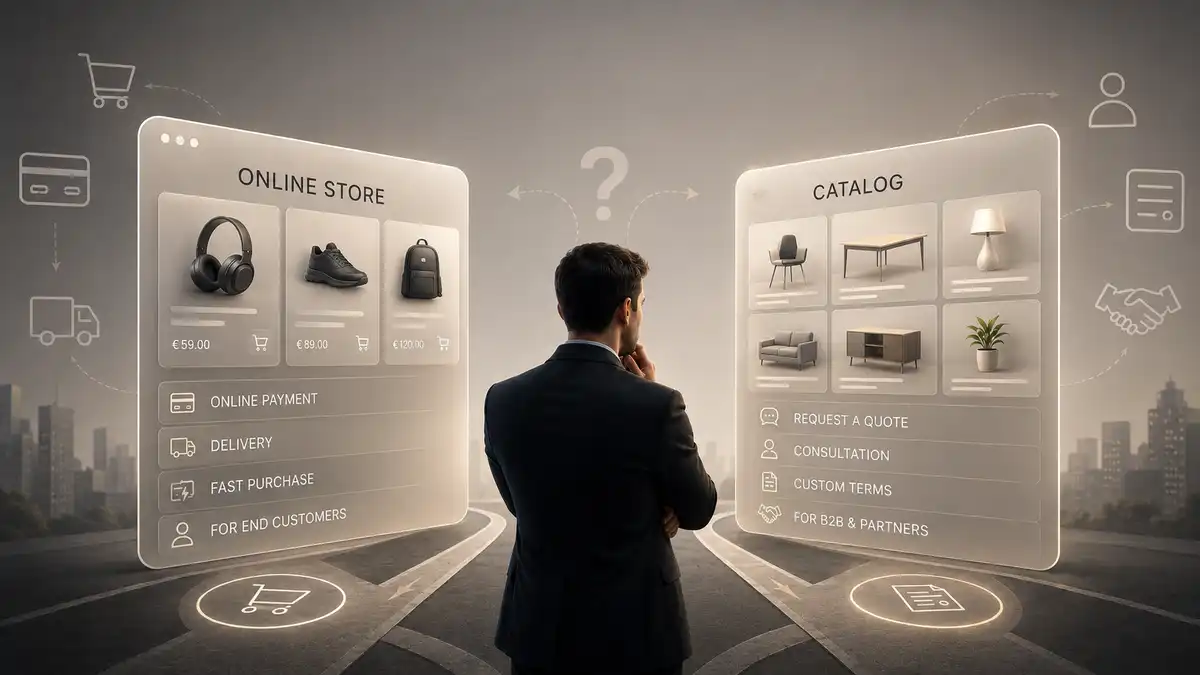
When a company wants to present products online, the first answer is often an online store. It sounds logical: products mean a basket, online payment, checkout and a customer account.
But having products to show does not automatically mean the business needs a complete online store.
In many sectors, customers are not ready to click “Buy” after viewing one product page. They need to confirm specifications, choose the right configuration, request an individual price, discuss delivery or check whether the product suits the job.
In such cases, the standard shopping cart does not simplify the purchase, but creates an artificial scenario that does not correspond to the actual sales process.
For some businesses, a catalogue website is more effective. It presents the range, helps people compare options, explains the differences and leads to the right next step: request a quote, speak to sales, get an estimate, order a sample or discuss partnership terms.
The main question is not whether the company has products. It is how customers decide and what should happen after they view a product.
Online store and catalogue solve different tasks
The online store is designed for a relatively clear and independent purchase.
The customer selects a product, sees the final price, adds it to the basket, enters their details, chooses delivery and pays. The company can fulfil the purchase without a lengthy sales conversation.
The catalogue website works differently.
Its job is to present the range, explain the differences and help potential customers take the next step.
This next step may be:
- requesting a price;
- booking a consultation;
- choosing a solution;
- ordering samples;
- requesting a wholesale quote;
- discussing tailored terms;
- finding the nearest stockist;
- connecting with a distributor;
- applying to become a partner.
A catalogue is not an “online store without a basket”. It is a distinct digital product with its own logic, structure and customer journey.
An online store guides customers towards self-service payment; a catalogue prepares them for a well-informed enquiry.
When a complete online store is the right choice
An online store works well when the main purchase terms can be standardised in advance.
The product has a clear price. Buyers can choose the model, size, colour or quantity. Delivery is calculated automatically, payment happens online and staff do not need to review every purchase manually.
This format suits fashion, cosmetics, electronics, accessories, household products and other standardised goods with fixed specifications.
Customers understand what they are buying, what it costs and when it will arrive.
The fewer questions left before payment, the more naturally e-commerce works.
A complete online store also makes sense when a business wants to scale a large volume of similar orders without constant manual involvement from managers.
In that model, the basket, online payment, notifications, documents, inventory management and delivery integrations genuinely reduce manual work.
But when every order needs clarification, a standard checkout starts to break down.
When the basket becomes superfluous
A shopping cart may look like a must-have part of a modern website, but in some business models it only complicates the customer journey.
Imagine a manufacturer whose cost depends on the volume of the order, the region of delivery, the type of packaging and individual terms of cooperation.
The website can show products, specifications and options while making clear that the final price depends on additional information.
If a manager still needs to contact the customer, recalculate the price and agree the terms after checkout, the basket creates a false expectation.
The buyer believes the order has been placed; the company treats it as a preliminary enquiry.
That mismatch damages the customer experience.
Another example is a product that requires consultation. Customers may see several similar options without knowing which one fits their project.
Instead of adding a random item to the basket, they want to ask a specialist.
In that journey, a prominent “Get advice” button can generate better-qualified enquiries than a standard “Buy” button.
Which businesses benefit most from a catalogue?
The catalogue is especially effective for manufacturers, wholesale suppliers, B2B companies and brands that sell through a partner network.
It is also suitable for businesses with custom products, individual calculations or a large number of options.
For example:
- construction-material manufacturers;
- furniture companies;
- equipment suppliers;
- packaging manufacturers;
- wholesale businesses;
- HoReCa suppliers;
- food brands;
- corporate-gift manufacturers;
- companies selling through distributors;
- bespoke-equipment businesses;
- technical-product suppliers;
- companies whose pricing depends on order volume or terms.
A catalogue is also useful when the website serves more than the end customer.
It can be used by partners, sales representatives, buyers, designers, architects or distributors. It is more important for them to quickly find features, options, documents and contacts than to go through a standard retail purchase.
Example: A brand with multiple product options
Imagine a company that makes a product in several flavours and pack formats.
The website presents five core products. One comes in nine flavours and three pack types. Selecting an option changes the image, description, ingredients, specifications and available order route.
Technically, this is more involved than a standard brochure page.
Customers should be able to explore the product, switch flavours, inspect the packaging and understand the differences without friction.
But this does not mean that the company needs online payment.
If products are shipped through stores, wholesale partners or discussed with the customer individually, the Buy button may not be appropriate.
Instead, use actions such as:
- “Request a quote”;
- “Become a partner”;
- “Check delivery terms”;
- “Order samples”;
- “Where to buy”;
- “Speak to sales”.
The result is a complete interactive catalogue. It presents the range clearly and helps customers choose without inventing an unnecessary payment step.
This matters especially for brands whose real goal is not one direct sale, but interest from a distributor, retail chain, restaurant, hotel or wholesaler.
A catalogue can sell without taking payment
The sale does not always end with a payment button.
In B2B and complex products, major conversions can occur much earlier.
For example, a potential customer may:
- find the right category;
- explore the range;
- choose a suitable option;
- download a technical document;
- send an enquiry;
- order a sample;
- book a consultation.
Each is a valuable commercial outcome.
The catalogue prepares the customer for a productive sales conversation and gives the team a better-qualified enquiry.
Instead of the message “Tell me what you have”, the company receives a specific request: the product, option, volume and contact details.
That lead is easier to handle because the sales conversation does not have to begin with a tour of the entire range.
Catalogue performance should therefore be judged not by online payments, but by how effectively it helps customers choose and begin the right sales conversation.
A catalogue should be more than a grid of product cards
A weak catalogue is a wall of similar images and product names. Customers see dozens of items but cannot tell how they differ.
A strong catalogue guides the choice.
It explains the range, presents meaningful categories and options, and makes product differences clear.
Filters and selection tools deserve particular attention.
Customers may need to filter products by:
- purpose;
- material;
- size;
- flavour;
- colour;
- application;
- packaging type;
- technical specification;
- price band;
- availability or delivery time.
Not every catalogue needs complex filtering. It may be excessive for five products, but even a small range needs clear logic.
If visitors do not know where to start, they will not inspect every product page individually.
Every product page should answer customer questions
Even without a basket, the product page remains one of the website's most important elements.
It should not just show a photo and a short description, but help a person make a decision.
A strong product page may include:
- a clear product name;
- high-quality photography;
- variants and options;
- key benefits;
- specifications;
- available sizes or packs;
- intended use;
- examples in context;
- documents and certificates;
- answers to common questions;
- delivery terms;
- related products;
- a clear next action.
For technical products, documentation, specifications, diagrams and compatibility matter.
For visual products, photography, detail shots, colour options and examples in use matter more.
For a food brand, ingredients, flavours, pack sizes, delivery formats and partner information may be essential.
The structure should follow the questions customers ask before ordering.
Why the “Contact Us” form often works poorly
Some catalogues end with a generic “Contact” button. Visitors reach a separate page, search for the form again and have to explain which product caught their interest.
Some potential customers drop out at this unnecessary step.
A contextual enquiry is better.
When someone is already on a product page, the system knows what they are viewing. The form can automatically include the product, selected option and category.
The customer only needs to add contact details, required volume or a question.
Instead of a generic button, use:
- “Ask for this product's price”;
- “Request wholesale terms”;
- “Check availability”;
- “Order a sample”;
- “Help me choose”;
- “Book a consultation”.
This language is clearer and closer to the customer's real task.
After submission, the data can flow directly into the CRM, including the selected product, chosen options and enquiry source.
Catalogues are especially useful in B2B sales
In B2B, a customer rarely makes a decision as quickly as in a regular online store.
The buying team compares suppliers, reviews specifications, checks documents, agrees terms internally and validates the budget.
The purchase can take days, weeks or months.
The website does not always need to secure immediate payment. It needs to provide enough information for the customer to take the right next step.
A B2B catalogue may need:
- downloadable specifications;
- tailored-price enquiries;
- a wholesale partnership form;
- minimum-order information;
- certificates;
- delivery terms;
- case studies;
- presentations;
- solution comparisons;
- direct contacts for the responsible team.
In this format, the catalogue becomes a sales tool that also supports account managers.
A sales representative can send one relevant page instead of attaching a stack of files to an email.
When details change, there is no need to circulate a new presentation to every partner. The current specifications remain available on the website.
The catalogue may have prices but no payment
Removing the basket does not mean hiding every price.
A company may show a fixed retail price, an indicative price or a range.
For example:
- “from €50”;
- “price depends on volume”;
- “recommended retail price”;
- “wholesale price on request”;
- “tailored quote”.
That transparency filters poor-fit enquiries and sets realistic expectations.
Show a price only when it genuinely helps the sale.
If pricing changes constantly, depends on dozens of parameters or varies by partner, an outdated figure will create more problems than it solves.
In that case, explain what drives the price and provide a clear route to a quote.
When you need a configurator instead of a catalogue
Sometimes a regular card is not enough.
If a customer assembles a product from multiple parameters, they may need a configurator.
For example, a customer selects the material, size, colour, shape and optional extras while the image and description update with each choice.
A configurator does not need online payment. Its job may simply be to help customers build a clear specification and send it to the company.
After selection, the system sends every parameter to the sales team. The business receives a structured specification instead of a vague message with missing details.
This approach is suitable for furniture, equipment, packaging, manufacturing, automotive accessories, building materials and other products with a large number of combinations.
This is an intermediate format between a regular catalogue and a complete online store.
When the catalogue is the first stage of the future online store
Sometimes a business does plan online sales, but is not ready to launch a complete online store right away.
The reasons may include:
- logistics are not ready;
- inventory records are unreliable;
- payment methods are still undecided;
- the product range is still taking shape;
- the business is testing demand;
- orders require manual confirmation;
- the company is entering a new market;
- the team is not ready to process online purchases.
In that situation, a strong catalogue is a sensible first step.
The company gains a modern website, presents its products and starts attracting search traffic and enquiries. At the same time, it learns which products interest the audience and which questions customers ask.
Later, you can add a cart, online payment, delivery and automatic documents.
That future development should be planned from the start.
If a catalogue is created on a temporary and poorly scalable basis, turning it into an online store may require a complete overhaul.
Therefore, even at the stage of architecture, it is important to understand business plans for the coming years.
Catalogue is not always cheaper than an online store
A common misconception is that a website without a shopping cart must be simple and cheap.
Sometimes that's true. A small manufacturer may need several categories, cards and feedback forms.
But an interactive brand catalogue can be more complicated than a standard online store.
It may include:
- bespoke design;
- animation;
- unconventional navigation;
- images that respond to selected options;
- multiple languages;
- complex product dependencies;
- filtering;
- a configurator;
- CRM integration;
- automated enquiries;
- interactive content;
- high-quality visual assets;
- technical documents;
- separate B2B and B2C journeys.
A standard online store is often built on an established e-commerce platform where basket, payment and order logic already exist.
In an interactive catalogue, many elements can be designed individually for the brand and its products.
Therefore, the format of the project cannot be evaluated only by the presence of the “Buy” button.
Complexity depends on the amount of bespoke logic, content, interface states and customer journeys.
How a Catalogue Helps SEO
A catalogue website can get search traffic just like an online store.
To do this, products and categories should have separate indexable pages with useful information.
If the entire assortment is on a single screen and only changes through JavaScript without separate URLs, it is harder for search engines to understand the structure of the site.
The right architecture creates indexable pages for categories, product types, applications and individual products.
Customers may search not for the company name but for:
- a specific product type;
- a material;
- an intended use;
- a packaging format;
- a wholesale supplier;
- a manufacturer in Slovakia or Europe;
- a technical solution;
- products for a particular industry.
Each useful page can answer a distinct search query.
SEO should not turn product pages into repetitive keyword containers.
If one product has nine flavours, nine near-identical pages may add little value. One strong page with a complete option switcher can be the better answer.
The decision depends on whether the audience is looking for each option separately and whether there is enough unique information for a standalone page.
The main task is to combine user convenience, catalogue structure and real search demand.
The catalogue must work properly on mobile
Many customers first discover the product on a smartphone.
Product pages, filters and option switches must therefore feel effortless on a small screen.
Pay particular attention to:
- image dimensions;
- loading speed;
- button placement;
- option switching;
- readable specifications;
- filter behaviour;
- easy access to the enquiry form;
- preserving the selected product when an enquiry is submitted.
If the catalogue contains many high-quality images, their delivery must be optimised. Otherwise, an attractive website will feel slow and lose customers.
Interactivity should aid choice, not complicate it.
How to choose between an online store and a catalogue
The decision must be made based on the purchase process.
Ask a few questions.
- Can customers determine the final price without speaking to sales?
- Can delivery be calculated automatically?
- Are products available for immediate purchase?
- Is consultation necessary before ordering?
- Do prices vary by customer?
- Does cost depend on volume, region or configuration?
- Does the business sell directly or through partners?
- Does every order require approval?
- Can payment and logistics be handled automatically?
If most terms are standardised, an online store may be the right solution.
If the purchase requires negotiation, calculation, selection or individual conditions, the catalogue will often be more effective.
Hybrid model: catalogue and the opportunity to buy
Businesses don’t always have to choose just one format.
Different scenarios can be combined on one site.
For example, standard products can be sold online at a fixed price while complex or wholesale items move through an enquiry.
Standard products have a “Buy” button, while tailored solutions use “Request a quote”.
Retail customers see a familiar online store, while B2B partners receive agreed terms after signing in.
The company may also direct customers to external stockists. A “Where to buy” button on the product page can open a choice of country, city or partner.
The hybrid approach allows you to take into account different audiences, but requires a particularly clear interface.
Customers should immediately understand which products can be bought now and which require an enquiry.
The biggest mistake: copying a competitor's model
A business owner sees a competitor's online store and decides to build the same thing.
But appearance alone reveals nothing about how well that system performs.
The basket may barely be used. Most orders may still arrive by phone, with staff manually confirming every purchase. Online payment may exist without matching the real process.
The website must be designed around the company's own business model.
Study:
- how customers buy today;
- which questions they ask before ordering;
- when the sales team becomes involved;
- why deals cannot close through self-service;
- which products are easiest to sell;
- where errors or delays occur;
- which features the audience genuinely needs.
The analysis may show that the company needs not a large online store, but a strong catalogue with useful product pages, fast enquiries and CRM integration.
Checklist: when a catalogue may be enough
The right digital product does not need every feature
It is easy to fall into the feature trap.
A modern website can seem incomplete without accounts, a basket, online payment, favourites, comparisons and dozens of extra features.
But each function must solve a real problem.
If customers simply need to choose a product, review the specifications and send an enquiry, a complex e-commerce journey only increases build and support costs.
The right solution is not always the most technologically demanding.
Sometimes a strong catalogue with clear navigation, useful product pages and effortless enquiries produces better results than a large online store nobody uses.
What matters is that the website matches real customer behaviour.
A catalogue as part of the wider brand experience
For a manufacturer or brand, the catalogue often becomes the centre of its digital presentation.
It shows not only the products, but also the level of the company.
Design, photography, structure and interaction communicate product quality, positioning and attention to detail.
A good catalogue supports advertising, sales, negotiations, trade shows and partner relationships.
The manager can send links to individual products. Advertising can lead to a specific category. A potential distributor can explore the range before the meeting.
A catalogue should never be treated as a technical product list.
It is a tool for brand, sales and trust.
Build the sales journey your business actually needs
Pump Agency helps businesses determine which digital project format fits the sales model.
We do not offer an online store just because the company has products.
First, we study how customers decide, whether they need advice, how pricing works, who processes the order and what happens after an enquiry.
Depending on that model, we can build:
- a brochure website with a catalogue;
- an interactive product catalogue;
- a multilingual website for European markets;
- a catalogue with connected options and dependencies;
- a product configurator;
- a B2B catalogue;
- a hybrid website combining purchases and enquiries;
- a complete online store;
- CRM, analytics and automation integrations.
Our goal is not to maximise the feature count.
We create a digital system that helps customers understand the product, choose confidently and take the right next step.
For one company, that action is an online payment. For another, it is a quote request, consultation, sample order or introduction to a distributor.
If the structure of the project corresponds to the real logic of sales, even a catalogue without a cart can become a strong tool for attracting customers and developing a business.
Discuss the project format