



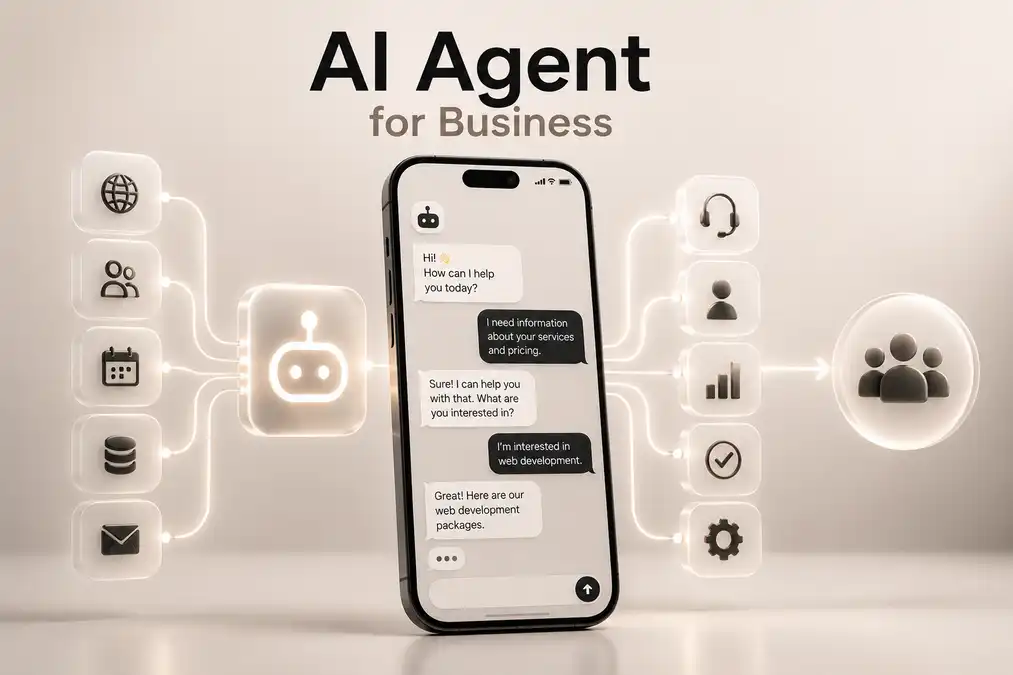
Until recently, most businesses saw artificial intelligence as a tool for copy, images, ideas and quick answers. Teams tried ChatGPT, drafted posts and emails, wrote product descriptions and gradually accepted Al as a useful assistant.
Now the next shift is under way.
Al is moving beyond the chat window. lt can receive a task, work with company data, make decisions within defined rules, access databases and trigger real processes with minimal human input.
This is what we call Al agents.
Put simply, an Al agent is more than a smart chat. lt is a digital operator connected to company knowledge, built around a specific responsibility and able to act inside business workflows.
Why Al agents go further than conventional chatbots
Many entrepreneurs have already encountered chatbots.
Most followed rigid scripts: press 1 for opening hours, press 2 to leave an enquiry, type a keyword to receive a predefined answer.
Such solutions could be useful, but they barely understood the context. They worked like a tree of pre-written answers.
The Al agent is different.
lt can understand natural language, consider the conversation history, consult a knowledge base, analyse data and respond to the meaning of an enquiry rather than a fixed keyword.
For example, a patient writes to a medical centre: “Hello, l have toothache after a filling. Can l come in today after 17:00?”
An ordinary bot can get confused or send a person to an administrator.
An Al agent can understand the enquiry, ask for the missing details, check available slots, suggest a time, book the appointment, send confirmation and issue a reminder.
The difference is huge.
An Al agent needs business memory
A strong Al agent does not appear out of thin air.
To be genuinely useful, it needs context: what the business does, which services it offers, its rules, prices, processes, restrictions, documents, common questions, products, schedules, CRM and other systems.
This is where a lot of people get it wrong.
They think an Al agent is just connecting ChatGPT to a website.
ln practice, a capable Al agent is built around a knowledge base and clear business logic.
lf it speaks to customers, it must understand the product, terms, tone of voice, opening hours, available services and limits of responsibility. lf it supports sales, it should know the pipeline, deal stages, typical objections, email templates and internal rules. lf it analyses a market, it needs reliable data sources, evaluation criteria and a useful reporting format.
Without that foundation, Al may sound polished but achieve very little.
Businesses do not need better small talk. They need useful work done.
How an Al agent can work with clients
One of the most obvious scenarios is customer communication.
Almost every company hears the same questions: How much does it cost? How do l book? Which services do you offer? What documents do you need? Can you do it today? How long will it take? What is the difference between these options?
These questions are usually answered by managers, administrators or business owners. Every day. Over and over.
An Al agent can take a meaningful share of that work off the team.
lt can respond on a website, Telegram, WhatsApp, lnstagram, Facebook Messenger or inside a CRM. lt can advise, clarify details, capture an enquiry, hand it to the right person, book an appointment, send confirmation and prompt the next step.
For the customer, it feels fast and straightforward.
For the business, it means less repetitive work, fewer lost enquiries and more consistent communication.
Al agents are not only for customers
Customer support is the most obvious example, but not the only one.
Al agents can work within the company.
A sales agent might analyse incoming leads, prioritise them, draft replies, flag stalled deals and prepare a concise customer history before a call.
A content agent can monitor competitors, gather ideas, analyse trends and prepare post outlines, video scripts and content plans.
An e-commerce agent can find products without descriptions, flag catalogue errors, draft copy, analyse the range, collect customer questions and suggest improvements.
An executive agent can prepare a daily digest of new enquiries, sales, issues, overdue tasks, reviews, campaign metrics and important changes.
This is no longer science fiction. lt is the next logical layer of automation.
Where an Al agent is especially useful for small and medium-sized businesses
Al agents work particularly well where there is repetitive information and repetitive processes.
Medical centres and clinics can use agents for enquiries, bookings, reminders and common questions. Garages can capture the vehicle make, the problem and a preferred visit time before passing the details to a technician. Construction firms can collect the property type, area, timeframe and budget, then structure the initial brief automatically.
Online stores can use Al agents for product selection, delivery advice, returns, sizing, compatibility and order updates. Education businesses can answer student questions, recommend a course and support customers after purchase. B2B companies can qualify leads, draft proposals and collect the right information before a meeting.
The main condition is one: the process must be clear and repeatable.
lf a business answers the same questions every time, then there is already potential for an Al agent.
Why an Al agent without automation is often useless
There is a big difference between an agent that only responds and one that takes action.
lf Al answers questions, it’s already helpful.
The real value appears when the agent can create an enquiry, message a customer, send an email, update a spreadsheet or CRM, create a task, check an order, compile a report, issue a reminder or route data to the right person.
That is why Al agents are often associated with automation tools: n8n, Make, Zapier, CRM systems, Google Sheets, calendars, Telegram bots, email, APls, and internal business systems.
ln that system, Al interprets meaning while automation carries out the action.
Together they become a working mechanism.
Why you can’t just put Al in and wait for results
Al agents can deliver a strong return, but only when they are designed properly.
A bad agent can hurt a business.
A poor agent can give inaccurate answers, promise services the company does not offer, misread a customer, quote the wrong price, lose enquiries or create chaos in the CRM.
That is why implementation should begin with the process, not the choice of Al model.
What exactly should the agent do? When must it stop and hand over to a person? Which data can it use? Which answers are off limits? How is quality checked? How are actions logged? Who owns the result? What happens when the agent is uncertain?
These questions sound boring, but they distinguish a working Al solution from a beautiful toy.
An Al agent needs clear boundaries
One of the hallmarks of a professional Al agent is that it does not try to answer everything.
lf a question sits outside its scope, the agent must hand it to a person. lf information is missing, it should ask. For legal, medical, financial and other sensitive topics, it must never impersonate expertise that belongs to a qualified specialist.
That discipline is critical.
Customers do not need Al that guesses.
They need a service that helps quickly and is honest about its limits.
How to implement an Al agent in a normal business
Good implementation usually begins with a process audit.
First, identify where the business is losing time, enquiries or money: repetitive questions, slow customer replies, spreadsheet chaos, weak lead handling, overloaded managers, poor task visibility or manual reporting.
Then one specific scenario is selected.
Not "automate everything."
Choose one concrete use case instead: handling website enquiries, booking consultations, capturing leads through Telegram, supporting a manager, building a content workflow or analysing competitors.
Then build the knowledge base, define the logic, connect the required services, test responses, configure restrictions and only then put the agent to work.
The best implementation almost always starts with a small scenario that can be quickly tested and improved.
What results can an Al agent give?
An Al agent can speed up customer responses, reduce pressure on the team, recover enquiries, improve service quality, standardise communication and free the owner’s time.
But there's another important effect.
Al agents help businesses become more systematic.
To create a good agent, you need to describe the processes, collect knowledge, structure services, write rules and understand where exactly the company is losing efficiency.
Even the process of preparing for Al implementation often improves business.
Because chaos has to be turned into a system.
Al Agents and the Future of Small Business
Small and medium-sized businesses have long competed under unequal conditions.
Large companies had sales teams, call centres, analysts, CRMs, marketing departments, support desks and automation.
ln a small business, it often rested on the owner, one manager and several employees.
Al agents are beginning to change that balance.
They allow a small company to respond faster, operate more consistently and use technology well without hiring a huge team. One well-designed agent can take on work that was previously spread across several people.
This does not mean that people will not be needed.
lnstead, people will become more important in tasks that require experience, empathy, strategy, negotiation, and responsibility.
Repetitive work, however, will increasingly move into automation.
Where should an entrepreneur start?
The best first step is not to look for the smartest Al.
The best first step is to find the most repetitive part of the business.
Where do you answer the same questions every day? Where are enquiries lost? Where do managers copy data by hand? Where do customers wait too long? Where is the owner still doing work that could become a system?
That is usually where the first useful Al agent is hiding.
Conclusion
Al agents are not a passing toy or simply another type of chatbot.
They are the next stage of business automation.
They help companies respond faster, handle enquiries better, collect data, run processes, support teams and turn a chaotic routine into a repeatable system.
But a strong Al agent does not appear on its own.
lt needs a knowledge base, clear logic, integrations, safeguards, testing and a connection to real business processes.
That is why Al agents should be considered not as a separate tool, but as part of the company’s digital infrastructure.
Want to know where Al will help your business?
Pump Agency builds Al agents and automation for real business tasks: enquiry handling, customer support, bookings, Telegram bots, content workflows, CRM, analytics, internal assistants and service integrations.
We explain Al plainly and show entrepreneurs where modern technology can create value without unnecessary complexity.
lf you want to understand where an Al agent can be useful for your business, start with one question: What routine do you no longer want to perform manually?
Discuss an Al agent