



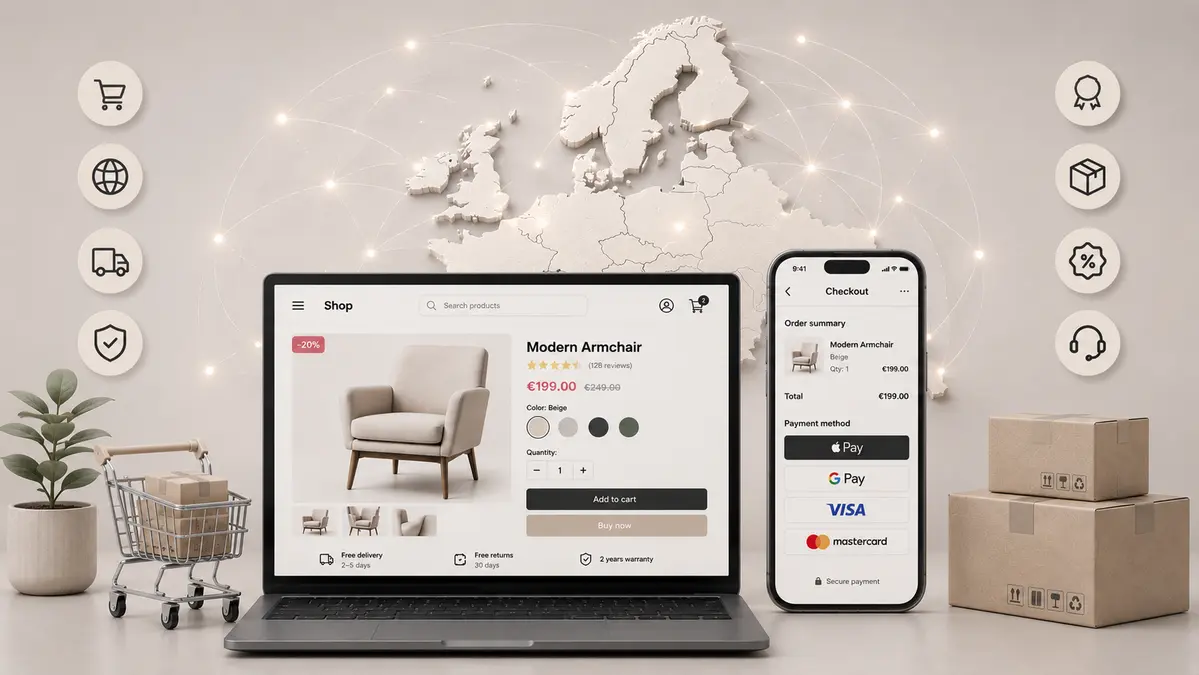
Opening an online store is now easier than ever. Platforms allow you to start sales in a matter of days, ready-made templates promise a quick start, and marketing is full of success stories about stores that began receiving orders almost immediately after launch.
But the reality of the European market looks a little different.
Having an online store is no longer a competitive advantage. In almost every sector, buyers can choose from dozens of sellers. A catalogue and a “Buy” button may once have been enough. They are not enough now.
A modern online store is a sales system: it must build trust, make buying easy, automate operations and support growth.
Why some online stores are growing and others remain a showcase
Imagine two entrepreneurs.
The first launches as quickly as possible: uploads products, connects payment and starts advertising.
The second treats the store as a business system, planning the catalogue, analytics, delivery, SEO, order automation and customer journey.
After a year, there is usually a huge difference between these stores.
For many online stores, traffic is not the real problem. The store loses customers after they arrive.
They cannot find a product, understand delivery costs, trust the seller, use a familiar payment method or see when the order will arrive.
The owner then increases the advertising budget to solve a problem that sits inside the buying experience.
What the customer expects from the modern eShop
User expectations have changed a lot in recent years.
Buyers are used to Amazon, Alza, Mall, Notino and other major retailers. Their expectations do not disappear when they visit a smaller store.
They want to find the right product quickly, see delivery costs, review genuine photography and specifications, and complete a straightforward checkout.
Across Europe, multiple languages, country-specific delivery and familiar local payment methods are increasingly basic expectations.
If an online store makes a person think too much, the customer goes to a competitor in just a few minutes.
An online store does not start with design
Many business owners begin with colours, fonts and visuals.
In practice, a good eShop starts with other questions.
How will the catalogue be organised?
How will the user search for products?
How will orders be processed?
Which countries will be served?
What payment systems will be used?
Which delivery services should be integrated?
What processes can be automated?
These answers affect sales far more than the colour of a button.
Automation becomes a mandatory part of eShop
One of the most expensive mistakes is to build an online store as if all processes will always be done manually.
It might work at the start. When orders increase, problems begin.
Managers transfer data between systems, update order statuses, email customers, check stock and prepare documents by hand.
Each operation takes time and creates a risk of error.
That is why modern online stores are increasingly integrated with CRM systems, warehouse accounting, payment gateways, delivery services and various automation scenarios.
The earlier it is embedded in the project architecture, the easier it is to scale the business in the future.
Why SEO remains one of the strongest sales channels
Many entrepreneurs rely solely on advertising.
Advertising works, but the flow stops as soon as the spend stops.
SEO works differently.
When an online store is structured properly from the start, product pages, categories and useful articles can all attract search demand.
This works especially well in the long run and when working in several European markets.
Essentially, quality SEO turns a website into an asset that continues to attract customers even without constantly increasing advertising costs.
Selling across several countries needs a deliberate approach
It is especially important for the European market to take into account the international structure of the project.
Entrepreneurs often assume that translating the website is enough.
In practice, it's much more complicated.
Different countries have different search queries, different customer expectations, different delivery services, and different payment methods.
Some businesses need dedicated market versions. Others need one multilingual platform. Some require country-specific pricing and localisation logic.
Such nuances often determine the success of an international e-commerce project.
What distinguishes a strong eShop from a regular store
If you look at successful projects, you can see one pattern.
They are not just a catalogue of products.
They build a clear and convenient customer path around the purchase.
The buyer quickly finds the right product, gets answers to questions, easily places an order and feels confident at each stage of interaction with the store.
The result is not only more orders, but more repeat purchases.
Repeat business often becomes the foundation of sustainable e-commerce growth.
Conclusion
A modern online store is no longer merely a website with products.
It is a business system combining sales, marketing, automation, analytics and customer service.
That is why successful stores are built around the logic of growth, not isolated design choices or features.
The earlier this logic is embedded in the project, the easier it is to scale, enter new markets and increase sales without constantly increasing operating costs.
Are you planning an eShop for Europe?
We design and develop online stores as complete sales systems, with a clear catalogue, sound SEO architecture, multiple languages, payments, delivery, analytics and process automation.
We analyse your market, launch countries and operational requirements so the store is ready not only for its first orders, but for the growth that follows.
Discuss eShop